

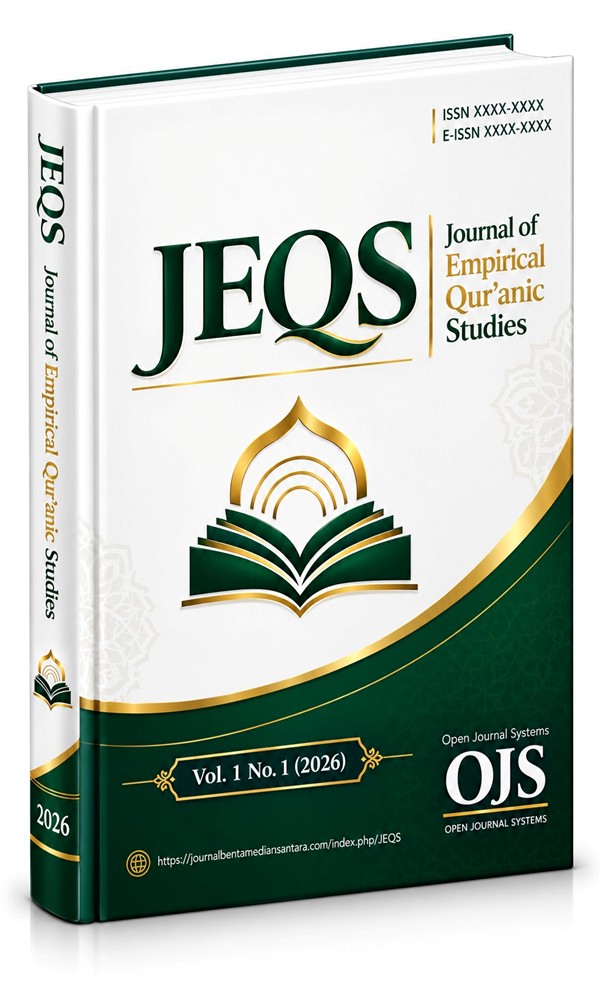
Vol. 1 No. 1 (2026): Journal of Empirical Qur’anic Studies (JEQS)
Published:
2026-06-30
Articles
-
Qur’an Memorisation in Tahfiz Education: A Systematic Review
 Universitas Islam Negeri Sultan Aji Muhammad Idris Samarinda
Indonesia
Qur’an memorisation in tahfiz education combines devotional preservation, oral recitation, disciplined repetition, semantic comprehension, and teacher-mediated correction. This systematic review synthesised evidence on pedagogical methods, digital tools, cognitive outcomes, and institutional conditions shaping contemporary Qur’an memorisation. The review used seven Scopus RIS exports dated 30 July 2026 and screened empirical, design, validation, survey, qualitative, modelling, and mixed-method studies published from 2016 to 2026. From 193 records, 35 duplicates were removed, 158 unique records were screened, and 60 studies were retained for narrative synthesis. The evidence clustered into four domains: digital and artificial-intelligence-supported memorisation; pedagogical, linguistic, and revision methods; curriculum and institutional pathways; and cognitive, affective, and well-being outcomes. The synthesis suggests that memorisation quality is not explained by repetition alone. It depends on an ecology of semantic cues, regular murājaʿah, teacher correction, suitable digital scaffolds, institutional time design, and ethical safeguards. The main limitation is that most included records were appraised from metadata and abstracts; therefore, full-text dual-reviewer validation remains essential before final journal submission.
Pages: 54-66Views: 12 Downloads: 9Neuro-Qur’anic Learning for Resilient Memorisation Through Brain Rhythm Method
Universitas Negeri Malang
Indonesia
Qur’anic memorisation quality depends not only on the amount of text retained but also on durable recall, tajwid accuracy, meaning-supported retrieval, focused learning, and resilient murājaʿah. This model-development article formulates Neuro-Qur’anic Learning based on the Brain Rhythm Method (NQL-MRO) as a testable pedagogical framework for adolescent ḥuffāẓ. Using a design-and-development logic, the manuscript synthesises practice-based accounts of MRO, tahfiz pedagogy, and memory-sensitive learning literature, along with reviewer-directed refinement, into a model that specifies learning components, classroom syntax, assessment indicators, and a validation pathway. NQL-MRO organises memorisation through intention and attention readiness, structural and semantic mapping, selective visual-tajwid coding, rhythmic auditory recitation, kinesthetic writing, bil-ghaib recitation with diagnostic feedback, and delayed murājaʿah. The model’s central contribution is the construct of memorisation resilience: the capacity to detect weakening, recover forgotten passages, and maintain prior memorisation while adding new material. The article contributes a concise theory of action, implementation tables, an operational scoring rubric, and high-resolution conceptual figures for future expert validation and empirical testing.
Pages: 24-38Views: 11 Downloads: 7English and Indonesian Qur’an Translation Research: A Scoping Review of Semantic and Ideological Evidence
Universitas Negeri Malang
Indonesia
Universitas Negeri Malang
Indonesia
Qur’an translation research increasingly examines how meaning is mediated through lexical choice, rhetorical structure, translator agency and digital method. This review maps a focused evidence base on English and Indonesian Qur’an translation, using a revised scoping-review logic grounded in PRISMA-ScR and JBI principles. The manuscript was revised from a pilot 33-record evidence map and strengthened through full-text analysis of three cornerstone studies on Indonesian translator ideology, repeated Qur’anic wa in English translation, and conceptual Qur’anic metaphor. The synthesis shows that Qur’an translation problems are not reducible to word equivalence: ideology may appear through translation technique and institutional authority; cohesion may be altered by implicitation or inaccurate rendering of conjunctive particles; and metaphor translation may lose conceptual mapping when literal transfer is used without cultural and exegetical control. The review contributes an integrated framework linking semantic density, rhetorical texture, exegetical mediation, translator agency and reader access. Future research should use full database exports, multilingual corpora and transparent charting variables to make Qur’an translation studies more cumulative.
Pages: 1-11Views: 23 Downloads: 15Qur’anic Identity Formation Scale-QIFS Equivalence among Indonesian and Sudanese Muslim Youth: A Prototype Demonstration
Indonesia
Universitas Islam Negeri Sunan Gunung Djati, Indonesia
Indonesia
Cross-national research on Muslim youth identity requires evidence that an instrument measures the same construct across linguistic, educational, and cultural settings before national scores are compared. This article presents a methodologically bounded demonstration of the Qur’anic Identity Formation Scale (QIFS), a 24-item framework intended to examine how Qur’anic meanings become textual self-understanding, moral orientation, communal belonging, and lived practice. The supplied dataset of 800 respondents from Indonesia and Sudan is explicitly treated as a prototype, not as field-validated evidence. Prototype multi-group confirmatory factor analysis illustrates configural, metric and scalar steps, with limited deterioration in fit across models; however, item loadings, thresholds, reliability coefficients, confidence intervals, recruitment documentation and response-process data were not available. The article therefore reframes the contribution from empirical proof to a transparent validation protocol. It shows why translation, local partnership, cognitive interviewing, ordinal-data modeling, item diagnostics, and differential item functioning checks are necessary before QIFS can support substantive comparisons. The argument is deliberately cautious: QIFS is a promising, scripturally specific, process-oriented framework, but its incremental validity and cross-national equivalence must be tested through field observations. The scale should be used to understand contextually mediated Qur’anic identity formation, not to rank national populations or evaluate religious worth.
Pages: 39-53Views: 6 Downloads: 5Mapping Digital Qur’an Studies: A Scoping Review of Evidence and Gaps
Universitas Negeri Malang
Indonesia
Universitas Negeri Malang
Indonesia
Digital Qur’an studies now include Qur’anic natural language processing, semantic search, question answering, mobile recitation and memorisation tools, user-experience research, and digital manuscript preservation. This scoping review maps the available evidence and identifies methodological and governance gaps across this heterogeneous field. Following PRISMA-ScR and JBI-informed scoping review logic, traceable scholarly records were screened from open publisher records, ACL Anthology, DOI-resolvable journal pages, and the five cornerstone references supplied for revision. The evidence clusters into four domains: computational Qur’anic resources, learning applications, digital philology, and user experience or religious-content governance. Computational studies show the strongest signs of maturity because they provide reusable corpora, annotated resources, semantic-search models, and shared question-answering benchmarks. In contrast, mobile learning and memorisation studies show practical innovation but rely mainly on prototype testing, expert review, user acceptance, and small-scale usability designs. Digital manuscript studies extend the field from application development to preservation, public access, and philological infrastructure. The review concludes that digital Qur’an studies should be treated as an emerging evidence landscape rather than a mature intervention field. Future work should prioritise validated learning outcomes, transparent source attribution, scholar-supervised AI governance, multilingual accessibility, privacy protection, and interoperability among corpora, applications, and manuscript repositories.
Pages: 12-23Views: 26 Downloads: 15