TEMPLATE


Indexed by:


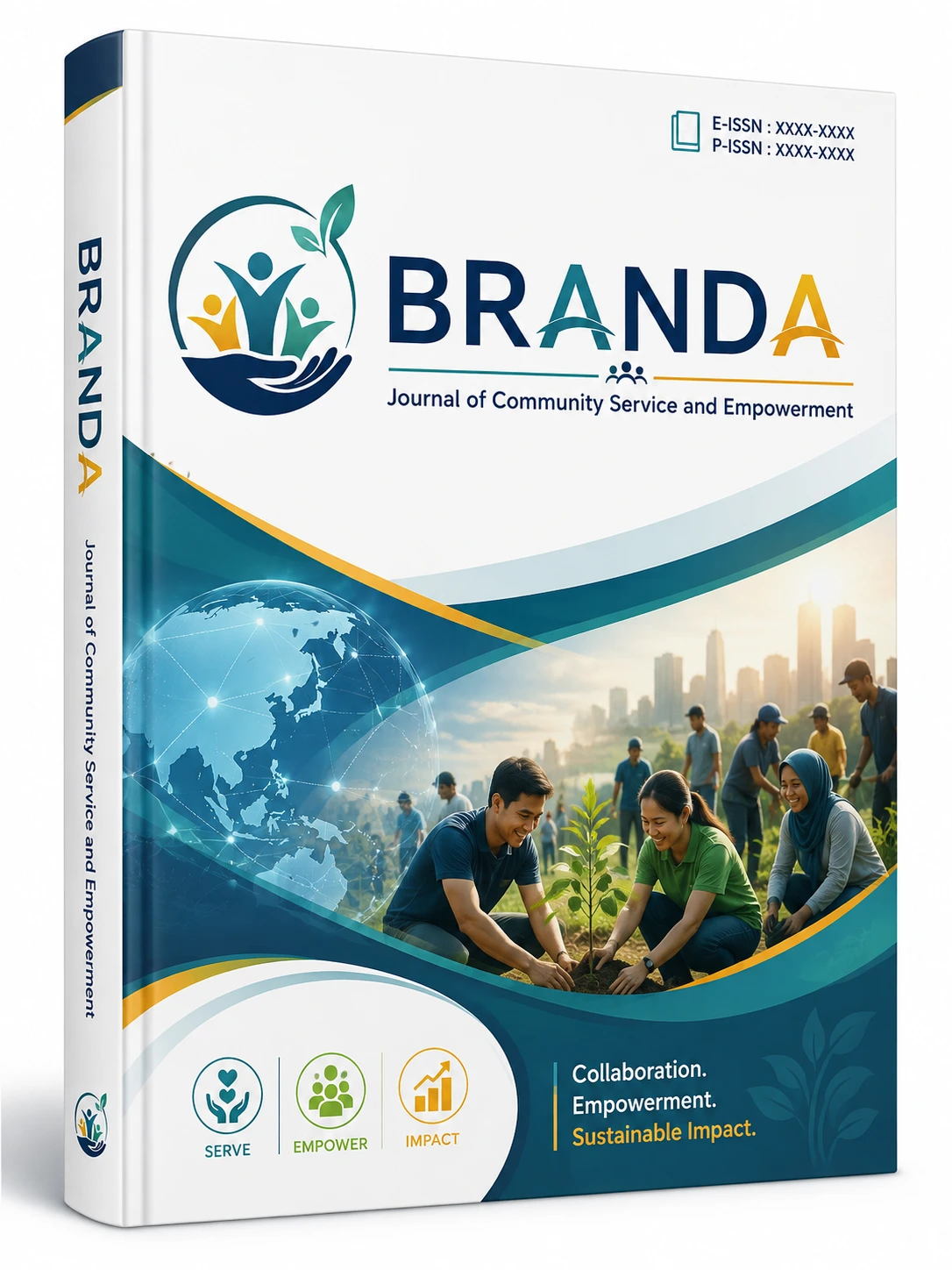
BRANDA: Journal of Community Service and Empowerment is an open-access and peer-reviewed scientific journal that serves as a primary platform for academics, lecturers, researchers, practitioners, and policymakers to disseminate the outcomes of research-based community service activities.
The journal focuses on the application of science and technology, transformative reflective actions, and multidisciplinary empowerment in response to dynamic global challenges. BRANDA aims to bridge academic expertise with the real needs of society to foster independence, sustainable welfare, and social justice aligned with the Sustainable Development Goals (SDGs).
Publication Frequency: Semiannually (June and December)
Approach: Interdisciplinary (Religion, Economics & Finance, Humanities, and Education)
Special Focus: Issues of inclusivity, social access, strengthening border areas, and underdeveloped regions (3T).
Vision:
To become a nationally and internationally reputable community service journal that excels in downstreaming multidisciplinary research, social innovation, and progressive thinking for the benefit and self-reliance of the wider community.
Mission:
To manage a professional, transparent, and accountable scientific journal in compliance with international accreditation and indexing standards.
To encourage collaborative, participatory research-based community service oriented toward social innovation and problem-solving in border and underdeveloped areas.
To disseminate critical ideas, humanities approaches, and best practices of community empowerment based on local wisdom and religious values for sustainable development.
BRANDA welcomes original articles originating from community service and empowerment activities that integrate credible theoretical approaches with empirical field practices.
The journal highly values innovative community service methodologies, including but not limited to:
Participatory Action Research (PAR)
Asset-Based Community Development (ABCD)
Community-Based Research (CBR)
Service Learning
The focus and scope of BRANDA cover the following five main pillars:
Application of research-based community service methodologies (PAR, ABCD, CBR, and Service Learning).
Rural and urban community assistance, strengthening local institutions, and community empowerment program designs.
Improving social access, community advocacy, and empowering communities in border regions as well as underdeveloped (disadvantaged) areas.
Community economic development, optimization of Village-Owned Enterprises (BUMDes), Cooperatives, and MSMEs, and increasing the competitiveness of local products through modern economics, econometrics, and finance.
Economic empowerment based on religious values and philanthropy (such as the management of Zakat, Infaq, Sadaqah, Waqf, and other social finance instruments).
Management training, market digitalization, and community economic recovery strategies in post-crisis eras.
Enhancing educator competence, developing adaptive curricula in partner schools, and strengthening Community Learning Centers (CLC).
Implementation of Education for Sustainable Development (ESD) to cultivate environmental and social awareness from an early age.
Community literacy movements, digital literacy, inclusive education, and technology adaptation in informal and non-formal education.
Strengthening religious moderation, community-based conflict resolution, and social harmonization in multicultural societies.
Preservation of local wisdom, development of arts and culture, local history, and strengthening humanities values in the face of modernity.
Community empowerment through faith-based communities and customary/indigenous institutions.
Public health education, stunting reduction interventions, and improving family food security.
Self-reliant environmental management, nature conservation, waste/sewage management, and community-based disaster mitigation.
Application of digital innovation and Appropriate Technology to enhance efficiency in agriculture, animal husbandry, fisheries, and renewable energy sectors in rural areas.
| Focus Area | Primary Target | Expected Output |
| Social Empowerment | Underdeveloped/Border Areas, Local Communities | Inclusivity, Institutional Strengthening |
| Economics & Philanthropy | MSMEs, BUMDes, Islamic Social Finance Institutions | Digitalization, Financial Independence |
| Education (ESD) | Schools, Community Learning Centers | Literacy, Adaptive Curriculum |
| Humanities & Religion | Multicultural Societies, Customary Institutions | Moderation, Cultural Preservation |
| Health & Appropriate Tech | Agricultural Sector, Families, Environment | Technological Innovation, Disaster Mitigation |
TEMPLATE

BRANDA: Journal of Community Service and Empowerment is managed and published by Branda Media Nusantara in collaboration with the Sociology Education, Yogyakarta State University are licensed under Creative Commons Attribution-ShareAlike 4.0 International