

About the Journal
- Journal Name : Journal of Educational Technology and Learning Arabic
- Initials : JETLA
- Frequency : Three in a Year, June, October and February
- Editor in Chief : Hasyim Asy'ari, M.Pd.I
- Online ISSN : 3165-0406
- DOI : -
- Indexed by : -
- Published by : Branda Media Nusantara collaborate LPPM Institut Agama Islam Al-Yasini Pasuruan
Current Issue
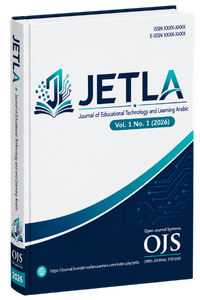
Vol. 1 No. 1 (2026): Journal of Educational Technology and Learning Arabic
Published:
2026-06-30
Articles
-
Reforming the Arabic Language Curriculum in Higher Education: Concepts and Models to Avoid Educational Failure
 Sunan Ampel State Islamic University Surabaya
Indonesia
College of Arabic Language and Da'wah of the Great Mosque of Sunan Ampel Surabaya
Indonesia
This study examines the need to reform the Arabic language curriculum in higher education by integrating scientific research with contemporary curriculum theory. Using a qualitative library research design with a content analysis approach, the study draws on books and scholarly articles as primary and secondary sources to examine relevant curriculum development models, including those of Tyler, Taba, Oliva, Beauchamp, Wheeler, Nichols, and the Dynamic Curriculum Development Model. The findings show that Arabic instruction benefits from a dynamic, cumulative approach, in which educators build students' vocabulary and skills through connected learning strategies that support deeper retention and understanding. By linking these theoretical models to practical curriculum design, the study highlights the university's role in integrating educational management, scientific research, and community service. The study offers practical guidance for revitalizing Arabic language instruction at the university level, aiming to prevent educational failure and produce graduates with strong linguistic competence.
Pages: 1-14Views: 30 Downloads: 38Arabic Phonological Errors in Reading and Their Implications for Meaning
STIT Hidayatunnajah Bekasi
Indonesia
STIT Hidayatunnajah Bekasi
Indonesia
STIT Hidayatunnajah Bekasi
Indonesia
This study analyzes phonological errors made by students at an Islamic junior high school in Karawang when reading Arabic texts and investigates their implications for meaning. Employing a qualitative case study approach, the research uses reading tests, interviews, and observation to collect data from one teacher and five students. The findings reveal three main types of phonological errors: substitution, addition, and omission. These errors are significantly influenced by internal factors, such as diverse educational backgrounds, limited articulation skills, lack of independent practice, and low self-confidence. External factors also play a crucial role, including the influence of the students' native languages (Sundanese and Indonesian), conventional teaching methods, limited use of audio-visual media, and a lack of supportive learning environments outside of school. The study demonstrates that these phonological mistakes directly affect the lexical meaning of words, often resulting in altered or lost meaning, which can impair reading comprehension. The research concludes that while teachers have implemented strategies like talaqqi and direct correction, these efforts need to be complemented with systematic phonological evaluations and the integration of audio-visual media to achieve optimal learning outcomes in Arabic pronunciation.
Pages: 15-26Views: 17 Downloads: 11View All IssuesA Diagnostic Assessment of Character Dimensions in Rural Elementary Arabic Classrooms
Universitas KH. A. Wahab Hasbullah, Jombang
Indonesia
Universitas KH. A. Wahab Hasbullah, Jombang
Indonesia
Universitas KH. A. Wahab Hasbullah, Jombang
Indonesia
Universitas KH. A. Wahab Hasbullah, Jombang
Indonesia
This study examines the cognitive and socio-emotional character dimensions of elementary school students in rural areas participating in Arabic language learning, using a diagnostic assessment framework. Data were collected from 49 students in grades 4 through 6 using a Likert-scale diagnostic instrument. Descriptive analysis showed a mean cognitive score of 17.39 (SD = 3.24) and a mean socio-emotional score of 36.55 (SD = 6.68), with the socio-emotional dimension showing both a higher level and greater variability. One-sample t-tests confirmed that both cognitive (t = 37.576, p < .001) and socio-emotional (t = 38.282, p < .001) scores were significantly above the test value, indicating meaningful internalization of both character dimensions across the sample. One-way ANOVA results, however, showed no statistically significant differences between grade levels for either dimension (cognitive: p = .900; socio-emotional: p = .129), indicating that grade progression alone did not account for variation in character development within this sample. These findings suggest that Arabic language learning activities contribute to character formation broadly across grade levels, with social-emotional competencies appearing more strongly and more variably developed than cognitive competencies, likely reflecting the influence of rural community and family context rather than grade-level maturation alone
Pages: 27-39Views: 16 Downloads: 13ChatGPT and Generative AI in Writing Instruction: Literature Review
UIN Sunan Ampel Surabaya
Indonesia
STAI di Tahdzib Jombang
Indonesia
This study is motivated by the rapid adoption of ChatGPT and other generative artificial intelligence tools in writing instruction across educational levels. The growing use of these tools raises questions about their actual pedagogical value, the reliability of the feedback they generate, and the risks they pose to academic integrity. This study aims to map the role, feedback quality, and challenges of ChatGPT use in writing instruction, and to identify implications for Arabic writing instruction. The method used is library research with a descriptive-analytical qualitative design. Data were collected from journal articles, books, and scholarly reports indexed in Scopus, Scite.ai, and Google Scholar, then analyzed through thematic content analysis. The results show that ChatGPT supports idea development, drafting, and surface-level language correction, but its contribution to higher-order feedback depends on prompt design and revision structure. AI-generated citations remain unreliable and require independent verification. User acceptance is generally positive but conditional on transparency and human oversight. Based on these results, it can be concluded that ChatGPT functions best as a complementary tool guided by teachers, not as a replacement for human judgment, and that Arabic writing instruction needs its own empirical evidence base for AI-assisted feedback design.
Pages: 40-54Views: 33 Downloads: 21Comparative Analysis of Arabic Language Curriculum Policy in Malaysia, Thailand, and Indonesia
STAI AL AKBAR Surabaya
Indonesia
STAI AL AKBAR Surabaya
Indonesia
Arabic language learning across Southeast Asia occupies a strategic yet uneven position, shaped by distinct sociocultural, religious, and institutional dynamics in each country. This study analyzes differences in curriculum models, teaching material effectiveness, and instructional methods applied in Malaysia, Thailand, and Indonesia, focusing on government policy, teaching material structure, and teacher pedagogical competence at the secondary education level. Using a qualitative comparative design with purposive sampling, data were collected through interviews, participatory observation, and document study, then analyzed through data reduction, thematic display, and conclusion verification. The findings show that Malaysia relies on a structured, technology-supported curriculum oriented toward academic linguistic competence; Thailand maintains traditional halaqah-based instruction oriented toward religious identity, with limited exposure to communicative Arabic outside the classroom; and Indonesia pursues a contextual, communicative approach across four language skills but faces substantial infrastructure and standardization disparities. A three-component language policy framework, comprising language management, beliefs, and practices, helps explain why strong central policy in Malaysia does not automatically translate into stronger learning outcomes without adequate teacher training and authentic language exposure. The study proposes a more flexible, context-sensitive curriculum model to address linguistic and structural barriers across the region.
Pages: 55-72Views: 33 Downloads: 27

Journal of Educational technology and Learning Arabic (JETLA) is managed and published by Branda Media Nusantara collaborate LPPM Institut Agama Islam Al-Yasini Pasuruan are licensed under Creative Commons Attribution-ShareAlike 4.0 International
Themes By
journal.brandamedianusantara.com